

The Wellthy Living Philosophy

Redefining Health After a Diagnosis
When I was first diagnosed with Crohn’s disease in 2019 at the age of 35, I believed health was a destination—a place I could arrive at once my symptoms were gone, and my labs were perfect. Once I got there, my body would be “fixed.”
The fear of what that diagnosis could mean for my quality of life quickly took over, and I became obsessed with doing everything “right.”
I believed I could perform my way to health and wellness. All I needed to do was follow a very strict set of self-imposed rules perfectly, for as long as it took, until I achieved optimal results on every conventional and specialty lab test.
That would prove I was no longer sick—and then I could move on with my life.
Case closed.
Of course, our bodies aren’t factories to be optimized. That’s not how healing works.

Overcoming Fear
Looking back, I have so much compassion for that version of myself. She was afraid—afraid of never being able to leave the house again, let alone travel.
She meant well, and she got the results she wanted, but not without creating new and more complex problems that ultimately prolonged her suffering.
She wasn’t just physically sick; she was mentally and emotionally frazzled, navigating a life-altering diagnosis during the chaos of a global pandemic, and she was spiritually starving.
A Shift in Perspective
What I’ve learned since—through years of experimentation, eventually reaching remission in 2023, and slowly transitioning from surviving to thriving—is that health and wellness are not destinations.
They are states of being.
They can’t be captured by a single test or protocol, but they can be cultivated when we understand health as a whole-person experience.
Health doesn’t start and stop with the physical body, despite what we’ve been led to believe. It encompasses the full spectrum of who we are and what we need as individuals—and those needs are fluid, shifting with our cycles, seasons, environments, and stages of life.
When we ignore those signals, the body often becomes the final messenger, communicating that something in our lives is out of alignment.
This understanding became the foundation of what I now call Wellthy Living.

Health is Wealth—But Not the Way We’ve Been Taught
I believe that optimum health and wellness form the basis of our greatest form of wealth.
Or as I like to say:
Wellness + health = wellth.
But what does that actually mean?
The World Health Organization defines health as “a state of complete physical, mental, and social well-being and not merely the absence of disease or infirmity.” The Global Wellness Institute defines wellness as “the active pursuit of activities, choices, and lifestyles that lead to a state of holistic health.”
Despite what diet and fitness culture often tells us, health and wellness aren’t just about eating better and moving your body more. Those things matter—but they’re only part of the story.
Wellthy Living is my approach to wellness that honors the belief that health is our greatest form of wealth—and that it is so much more than what you eat, how you move, or what your lab results say.
After years of striving for perfection through biohacking, rigid protocols, and external metrics, I realized that true well-being isn’t something you achieve and maintain forever. It’s a dynamic, ongoing relationship with your whole self.
The 4 Foundational Aspects of Holistic Health
At the core of my Wellthy Living
Philosophy is the understanding that we are multidimensional beings. Our well-being is supported by four foundational aspects of holistic health:
- Physical health – The state of your body, including the presence or absence of disease, genetics, nourishment, movement, and rest.
- Mental health – Your beliefs, inner narrative, relationship to stress, resilience, and the information you consume.
- Emotional health – Your ability to feel, process, and be present with your emotions, and the quality of your relationship with yourself and others.
- Spiritual health – A sense of meaning, purpose, values, and connection to something greater than yourself, expressed through aligned thoughts, words, and actions.
These foundational aspects are deeply interconnected. When one is out of balance, it disrupts the others.
True wellness happens when we tend to all of them—not with rigidity or perfectionism, but with presence, compassion, curiosity, and flexibility.
The Seven Pillars of Wellth
Over time, I began to notice something powerful: as I changed my habits, thought patterns, and behaviors across different areas of my life, they created a ripple effect.
My nervous system became more regulated. I grew more resilient. I had more energy. My body began to heal. I felt more grounded, more connected, and more abundant—and I developed a deep sense of gratitude for the life I was actively creating.
I was no longer just addressing my physical health. I was supporting my mental, emotional, and spiritual well-being through intentional self-care practices that nurtured seven key areas of life.
These became what I now call the Seven Pillars of Wellth:
- Environment – The physical and energetic spaces you live and move within.
- Food – What, when, and how you nourish yourself, and the recipes you prepare.
- Movement – The ways you move your body, how often, and why.
- Relationships – The quality of connection you have with yourself and others, as well as the plants, animals, and physical objects you share space with.
- Rituals – Routines practiced with intention and presence.
- Contribution – The ways you share your time, energy, creativity, presence, and gifts with the world.
- Rest – The practices that allow you to reset, restore, and integrate mind, body, and soul.
These pillars aren’t made of hard and fast rules. They are invitations— opportunities to create specific and meaningful self-care practices that support every aspect of our health, in ways that are deeply personal and ever-evolving.

The Wellthy Living Web
Together, these seven pillars form the Wellthy Living Web—a living, interconnected system that’s constantly evolving. Like a spider tending her web, we are continually re-evaluating, adjusting, and responding to change, activating various pillars as we navigate life.
As the astrologer Olivia Woodford once wrote, “Priorities may shift, and the web we are weaving may need to alter its design in response to the winds of circumstance.”
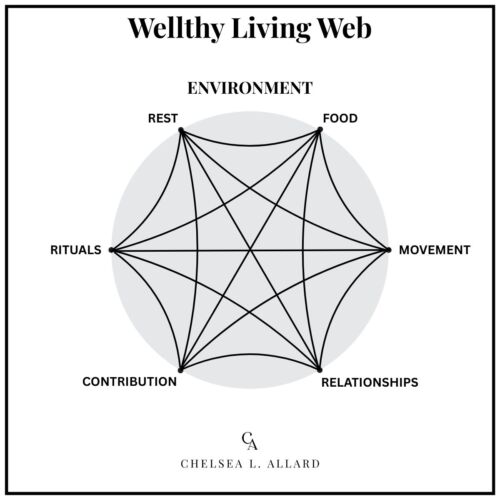
Some seasons call for more rest. Others ask for deeper connection, more movement, or a new form of nourishment. There is no one-size-fits-all formula, and balance isn’t a permanent, static state—it’s fluid.
Well-being isn’t defined by perfection. It’s defined by how attuned we are to our needs, how connected we feel to our lives, and how intentionally we respond to the season we’re in.
This is wellthy living: a sustainable, restorative, and holistic way of being—where health is not the goal, but the natural result of living in deeper alignment with your whole self.
If this idea resonates with you, I invite you to subscribe to my Substack, WELLthy Living with Chelsea L. Allard, below. ⬇️

I really resonate with the idea of the web- for so long I hyper focused on one or two aspects, at the detriment of the others- thinking that if I just looked like this or just had this person in my life, things would feel good. I’m so glad we are starting to see that “if only” way of thinking as a relic of the past. Of course the way forward is integration of all of our parts. I look forward to reading more!
I’m so glad that resonated. Once you start to see how everything is connected, it becomes so obvious that the quality of one area deeply affects the others. I think more and more people are starting to see it, which gives me hope.